The Attention Invoice
How AI slop transfers its cost to everyone else.
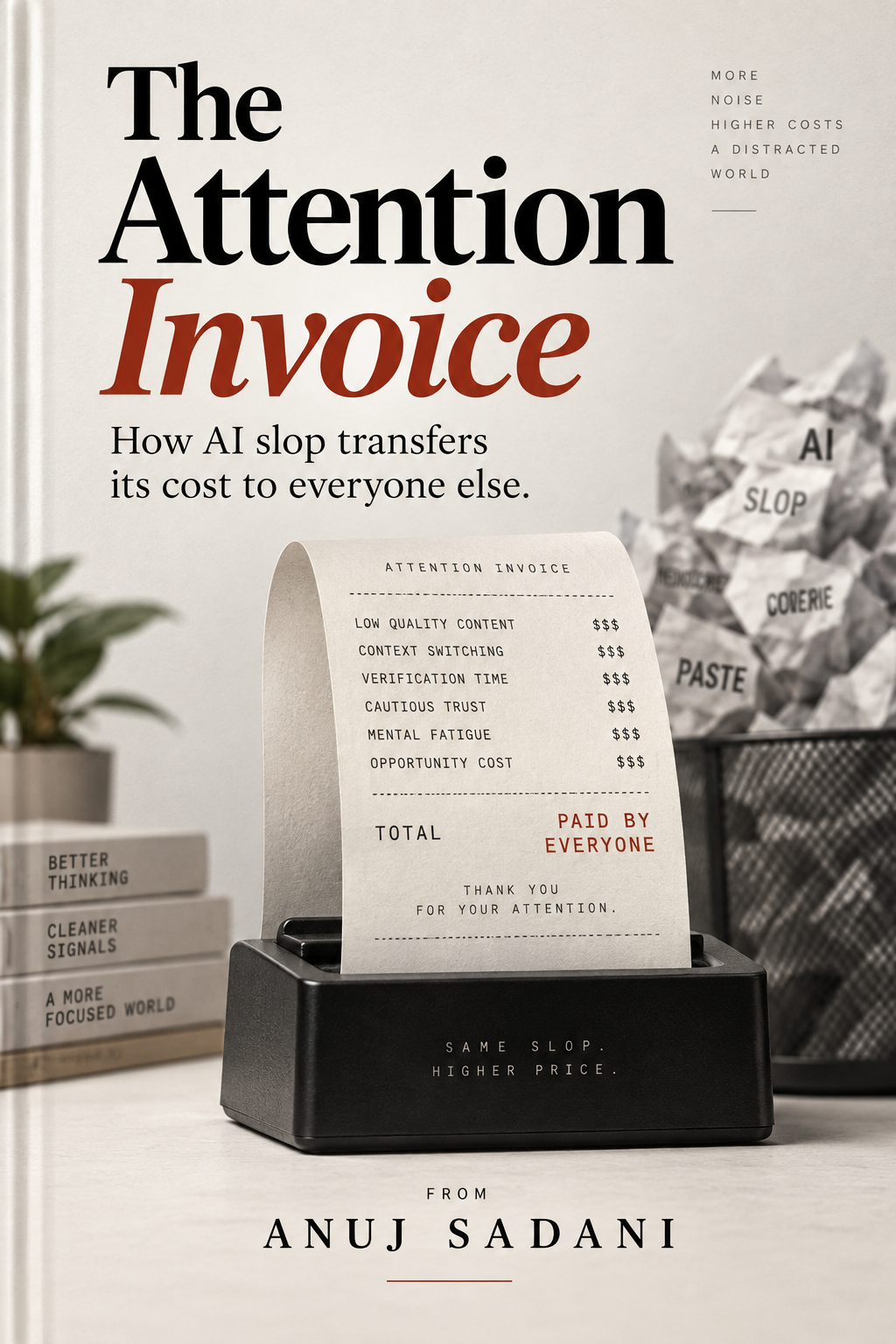
This book is an argued essay, not a claim that the boundary of “AI slop” can be measured precisely. Its factual claims are footnoted to the source that supports them. Its central position is the author’s: the important distinction is not between human and machine tokens, but between work that has received judgment and work that has merely been produced.
↗ Get the full PDF on Ko-fi- 01What Is AI Slop?the definition LinkedIn gets half right
- 02The Argument About the Wordthree writers, one output, different judgment
- 03When Output Became Cheapwhat changed, and what didn't
- 04The Artifact Cannot Tell Youwhy detection is the wrong question
- 05The Price Paid by Readersthe attention invoice, itemized
- 06When Slop Enters the Repositorythe cost of unreviewed judgment at work
- 07The Responsibility Testa question sharper than "did AI write this"
- 08What to Do on Mondaythe practice, not the ban
- —Notes & Sourceswhere the claims come from
Copyright, permissions, and how this was made
The Attention Invoice — an essay on what "AI slop" names, and who ends up paying for the attention it wastes.
Copyright © 2026 Anuj Sadani.
All rights reserved. Quote it in a review or a piece of criticism with attribution; anything further, please ask.
A note on how this book was written
An AI system drafted this book. Not "assisted with" — drafted it, from the outline through to the prose you are reading. I set the question and its boundaries, made the judgment calls, argued with the drafts, and put my name on the result. The errors are mine; the model does not get to share the blame.
If that makes you wince, I understand the reflex. The internet is full of confident, sourceless, frictionless text, and the reasonable response has been to distrust anything that reads too smoothly. But the objection worth taking seriously is not that a machine wrote it. It is that nobody checked it.
This one carries no formal verification gate — it is an argument rather than an audit, and you should read it as one. Where it leans on a number or a study, the source is named so you can go and disagree with it at first hand.
And if you notice the em-dashes, they are mine. I have always written this way. Make your peace with them.
— A.S.
First edition · 2026
What Is AI Slop?
LinkedIn now has a feedback option called “Seems like AI slop.” Open the menu on a post, choose it, and LinkedIn treats that as a signal that the post did not feel valuable. It does not remove the post or make a policy finding about its author.1
The feature is useful because it names a feeling that has become familiar. A person opens a post promising an insight about leadership, AI agents, or the future of work. The prose is smooth. The paragraphs are clean. There is a confident opening, a tidy list, and a final lesson. Then the reader reaches the end and realizes that no one has actually said anything.
But the label also creates a confusion. People hear “AI slop” and infer “text that an AI wrote.” That is too broad to be useful. An AI can help a person research, outline, translate, edit, test an argument, or make a difficult idea clearer. None of those acts makes the result slop.
The real question is harder: did someone exercise enough judgment to make this worth another person’s attention?
The distinction LinkedIn gets right
LinkedIn’s own definition is better than the name of its button. It describes AI slop as low-effort, likely AI-generated content that sounds polished on the surface but lacks a point of view, unique perspective, or substance. It says the distinction is not how content was created, but whether it adds value and reflects a person’s perspective, experience, or expertise.2
That is the right center of gravity. The generated sentence is not the offense. The unexamined sentence is.
Imagine three people publishing an article about AI agents:
| Process | What happened | Slop? |
|---|---|---|
| Generate → publish | A model produces 1,500 words and the author pastes them into a post. | Usually. |
| Human idea → AI draft → human edit | The author supplies a thesis, examples, corrections, and a real rewrite. | Usually not. |
| Human research → AI synthesis → human judgment | The author decides which sources matter, checks the claims, and stands behind the conclusion. | No. |
The table is intentionally about process rather than style. The visible artifact is a weak signal. A heavily directed and carefully edited piece can retain the rhythm of a model. A person can write generic, derivative, attention-seeking prose without touching an AI. Manual typing has never been a reliable measure of thought.
Two articles can therefore look similar while being fundamentally different. One may be prompt, generate, publish. The other may contain an idea, reporting, context construction, criticism, correction, and verification before the final generation. A reader cannot reliably see that history from punctuation, em dashes, headings, or an AI-detection score.
Calling both pieces slop because both contain generated tokens collapses authorship into keystrokes. Authorship is better understood as the work of choosing: choosing the question, the evidence, the examples, the omissions, and the words one is prepared to defend.
A family resemblance, not a test
There is no settled technical definition of AI slop. A recent scholarly paper argues that it has resisted formal definition and proposes three recurring properties instead: superficial competence, asymmetric effort, and mass producibility.3
Those properties explain why the phrase feels precise even when its boundary is fuzzy.
Superficial competence is the polished shell. The grammar works. The image looks plausible. The memo has the expected headings. Underneath, the claims are unsupported, the summary never gets specific, or the apparent conclusion is just the premise repeated in better phrasing.
Asymmetric effort is the production problem. It takes seconds to make a convincing-looking artifact and much longer for another person to decide whether it is accurate, useful, or original. The producer gets the convenience; the reader, reviewer, customer, or colleague inherits the verification cost.
Mass producibility is the ecosystem problem. One mediocre image or awkward paragraph is not necessarily what people mean by slop. The term becomes more apt when a system can make thousands of near-substitutes for search rankings, ad impressions, engagement, or the appearance of output. Reporting on the rise of the term has repeatedly connected it to low-quality text, images, videos, and entire sites produced cheaply for search traffic.4
None of these is a pass-fail test. A personalized surreal image can be silly and still mean something to the person who made it. A concise generated answer to a narrow question can be exactly what someone needs. The scholarly account makes this point too: so-called slop can meet demand for niche or personalized content and can carry aesthetic or social value.5
That is why “I dislike it” and “it is AI slop” should not be interchangeable. The term is most useful when it names a failure that affects someone beyond the author: an output that asks for attention, trust, or review without having been given enough thought to earn any of them.
The missing word is judgment
The usual list of tells is familiar: generic language, repeated ideas, unnecessary length, fake profundity, too many headings, confident claims with no evidence. Those are symptoms. They matter because they suggest an absence of judgment, but none proves it.
A person can use every fashionable AI writing habit and still make an original, careful argument. Another can avoid every tell and publish a confident falsehood they wrote alone. The important difference is whether someone took responsibility for the content: checked what could be checked, removed what did not hold up, supplied the context a model could not know, and decided that the piece had a reason to exist.
This makes a better working definition:
AI slop is generated output whose cost of production has fallen much faster than the effort spent deciding whether it deserves to exist.
Or, in the shortest form: AI slop is a failure of judgment, not a method of generation.
The definition does not let every AI-assisted author off the hook. It raises the bar in the place that matters. If a model makes drafting cheap, then choosing, checking, and editing become more valuable, not less. The person who publishes the result still owns the claim.
The software version of the same problem
This is not only a problem for feeds. Generative AI can produce code, documentation, tests, issue comments, design notes, and pull requests much faster than a team can understand them. The same asymmetry appears: generating an artifact is cheap; reviewing it, maintaining it, and recovering its rationale are expensive.
The danger is not that AI wrote a function. A well-directed model can remove drudgery and leave more time for work that needs judgment. The danger arrives when a team measures generated volume as if it were progress, accepts code that nobody can explain, or creates documentation that no one has verified against the system it describes.
That is engineering slop: artifacts that create the appearance of movement while increasing uncertainty about why they exist, whether they are correct, and who understands them. The technical debt is not simply AI-generated code. It is the gap between what the repository contains and what its humans can account for.
The practical response is ordinary, even if the tools are new. Ask before publishing or merging: What is the point? What is new here? What did we verify? Who will own this when it breaks? If those questions do not have good answers, the artifact is not finished merely because it looks finished.
LinkedIn’s button cannot reconstruct the invisible process behind a post. No detector can do that reliably either. But the phrase can still be useful if it reminds us what readers are reacting to: not the presence of a machine, but the absence of a mind that cared enough to decide.
The Argument About the Word
“Slop” is a hostile word. That is part of its usefulness and part of its risk. It carries the picture of something poured into a trough: plentiful, uniform, barely worth choosing. It is not a neutral description of a production method.
That matters because the word is now used for at least four different complaints. Sometimes it means false information. Sometimes it means ugly or derivative culture. Sometimes it means a volume problem: too much content competing for the same attention. And sometimes it means a moral complaint about a creator who outsourced too much of the work.
Those are related, but they are not the same.
A fabricated local-news story is dangerous because it can be false. A hundred perfectly grammatical product descriptions can be useless because they add no information. A strange AI video made for one family may be neither useful nor dangerous; it may simply be a new form of play. If every one of these is called slop, the word stops helping us decide what to do next.
The academic account of the term is unusually careful here. It does not offer a test that separates slop from non-slop. It offers a family resemblance: superficial competence, asymmetric effort, and mass producibility.6 That is a better starting point than an AI detector because it points at the social conditions around the artifact.
The boundary will remain fuzzy because value is contextual. A generated bedtime story made for one child may be cheap to create and deeply valuable to that child. A heavily researched report may use model-written sentences and still earn attention because the author made the decisive choices. The object does not announce its process.
The question is therefore not “Was AI used?” It is: what burden did this artifact place on other people, and what care did its maker take before placing it there?
In practice
- Name the failure precisely. Say false, repetitive, derivative, or unreviewed when that is what you mean.
- Do not make style a verdict. Smooth prose is neither evidence of care nor evidence of its absence.
- Reserve “slop” for the larger failure. It is most useful when cheap output has shifted verification, attention, or cleanup onto somebody else.
When Output Became Cheap
For most of the internet’s life, publishing imposed a small amount of friction. Someone had to write the article, make the image, record the voiceover, or assemble the page. The cost was never high enough to guarantee quality. It was high enough to force a choice.
Generative systems changed the shape of that choice. They did not make judgment cheap. They made the artifacts that normally signal judgment cheap: paragraphs, illustrations, outlines, summaries, scripts, reviews, and code.
That creates a predictable temptation. When the cost of production falls, the producer can run more experiments. Some experiments are good: a teacher can make an explanation for a student who needs it; a small business can translate a manual; an engineer can draft a test case. Others are attempts to capture attention at a price close to zero.
Content farms have found the second use especially attractive. NewsGuard’s tracker describes thousands of unreliable AI-generated news sites operating with little or no human oversight. It reports that such sites often publish dozens of articles a day, and that programmatic advertising can reward them without regard to the quality of the site carrying the ad.7
The important fact is not that the articles are machine-written. The business model does not need a reader to learn anything. It needs a page to be indexed, clicked, and shown an advertisement.
This is why scale changes the moral texture of mediocre content. A weak essay asks for five minutes. Ten thousand weak essays change the cost of finding anything strong. They turn discernment into unpaid labor for everyone downstream: the reader searching, the editor reviewing, the platform ranking, the model training on the resulting web.
Cheap supply does not create demand for meaning. It can, however, create a great deal of material that resembles meaning at first glance.
In practice
- Measure a publishing system by reader benefit, not artifacts shipped.
- Ask what each item is for. “To rank” and “to help a reader decide” are not interchangeable purposes.
- Put human review where distribution is automated. Scale without review is the condition in which a small quality problem becomes a public one.
The Artifact Cannot Tell You
A reader sees the final text. They do not see the notebook beside it, the rejected drafts, the source tabs, the fact check, or the moment someone removed a sentence because it could not be defended.
This is the central difficulty in calling something AI slop. We can observe the artifact and infer from it. We cannot observe the process that produced it.
The familiar tells are weak evidence. Certain transitions, an abundance of headings, em dashes, a polished but generic cadence: these may suggest a model, but they do not tell us whether an author supplied a real claim, constructed the context, or checked the result. A detector faces the same limit. Even if it identified machine-generated prose perfectly, it would identify generation, not judgment.
The opposite error is equally common. A human can type every word of a vague, derivative post. The labor is real; the contribution may still be zero. We should not confuse authorship with keystrokes.
Authorship is the chain of decisions that makes an artifact answerable: why this question, why these sources, why this example, why this conclusion, why now. AI can participate in that chain. It cannot remove the need for someone to own it.
This is why disclosure alone is not a quality test. “Written with AI” can be honest and still leave a reader with no reason to trust the work. “Written by a human” can conceal carelessness. The more useful convention is responsibility: the named author should be able to explain and defend the work.
In practice
- Keep an evidence trail for consequential work. A short list of sources and decisions is more meaningful than a purity claim about tools.
- Use disclosure to clarify process, not to borrow credibility.
- Ask the author question. Can the person whose name is on this explain why the claim is here and what would change their mind?
The Price Paid by Readers
The complaint about AI slop is often described as aesthetic: too many strange images, too much bland prose, another LinkedIn post that sounds like every other LinkedIn post. That is real, but it is not the deepest cost.
The deeper cost is attention. Every plausible-looking low-value artifact asks a reader to make a small investigation. Is this true? Is it copied? Is there a real person behind it? Is the advice specific enough to use? Each investigation is cheap in isolation. At scale, it makes the information environment tiring.
That fatigue changes behavior. Readers skim more aggressively. They trust less. They favor familiar sources because checking new ones is expensive. Small publishers and careful novices then pay a tax created by people who can flood the same channels with cheaper imitations.
Researchers discussing AI slop describe the asymmetry directly: output can take far less effort to generate than a comparable human-made artifact, while its surface competence can disguise a lack of substance.8 The reader must do the expensive part after the producer has skipped it.
The problem resembles spam, but only up to a point. Spam filters work because many messages share patterns and because the cost of a false negative is often low. Slop may be persuasive, topical, and nearly correct. The most expensive cases are not absurd. They are the calm, credible paragraph that leaves out the one condition that matters.
This is also why a blanket hostility to synthetic media is a poor answer. The goal is not a return to a world where only people with spare time can publish. The goal is a world where the cost of publishing does not become an invoice sent to everyone who reads.
In practice
- Respect attention as a finite resource. Do not publish a summary when a link and one sentence would do.
- Make claims checkable. Link the source, name the uncertainty, and remove decorative certainty.
- Reward useful specificity. It is harder to mass-produce and easier for a reader to test.
When Slop Enters the Repository
Software teams are beginning to meet the same problem in a form they recognize immediately. An AI assistant can generate a feature branch, a test suite, a migration, a design memo, and a pull-request description before the reviewer has finished reading the ticket.
The code may run. That is not the end of the question.
Code has a longer afterlife than a post. It will be reviewed, deployed, debugged, changed by someone new, and used as evidence of how the system works. A patch that its author cannot explain transfers all of that future reasoning to other people.
A recent paper frames this as a software commons problem: individual gains from AI-generated output can externalize costs onto reviewer capacity, codebase integrity, shared knowledge, and collaborative trust.9 Another qualitative study of developer discussion identified review friction and quality degradation as central themes in complaints about AI-assisted software development.10 These are early accounts, not settled measurements. They are still useful because they name where the cost appears.
The engineering version of slop is therefore not “code made with AI.” It is code that creates the appearance of progress while increasing uncertainty about behavior, rationale, and ownership.
The crucial question is not whether the assistant wrote the first draft. It is whether a human can trace the change from requirement to design to tests and can carry the responsibility when it fails. When that chain exists, AI can reduce drudgery. When it does not, generated volume becomes technical debt at production speed.
In practice
- Review for explanation, not only execution. A passing test is necessary; an understood change is durable.
- Require a rationale for non-obvious code. Generated comments are not a rationale unless someone verified them.
- Keep changes small enough to own. A reviewer should be able to say what changed, why it is safe, and who will maintain it.
The Responsibility Test
There is no reliable detector for care. That does not leave us helpless. It means the standard should be behavioral rather than forensic.
A useful responsibility test has five questions.
What is the point? A piece should be able to name the question it answers for a particular reader. “Content about AI” is a category, not a point.
What is new here? The answer may be a firsthand observation, a synthesis, a worked example, a useful framing, or a decision. If nothing is new, a link is usually better than a post.
What was checked? This does not demand impossible certainty. It demands that a publisher distinguish verified facts, interpretation, and speculation.
What was removed? Editing is evidence of judgment. The sentences that did not survive are often more important than the sentences that did.
Who owns the result? The person who publishes or merges should be able to answer questions about it without blaming the model.
This test is deliberately indifferent to how many tokens a machine produced. It makes room for a writer who uses AI extensively and for one who uses none. It also makes the actual obligation visible: publishing is a promise to bear some of the reader’s verification burden yourself.
In organizations, this should be a process rather than a cultural wish. People need enough time to read outputs, enough permission to say “this does not add up,” and incentives that do not reward artifact count over outcomes.
The strongest defense against slop is not better taste. It is a system in which care is cheaper to exercise than carelessness is to pass downstream.
In practice
- Add the five questions to publishing and PR templates.
- Treat uncertainty as useful information. “We do not know” is often the most valuable sentence in a report.
- Make ownership explicit. A named owner is not decoration; it tells others where understanding is supposed to live.
What to Do on Monday
The useful response to AI slop is not to ban tools or to become a detective of punctuation. Both answers attack the visible surface and miss the real failure.
Start with the work that leaves your hands.
Before publishing, ask whether the piece contains a claim, a reader, and a reason. Remove the paragraph that only restates the title. Link the source that carries the fact. Replace a generic example with the actual case that changed your mind. If the answer is not ready, keep it as a note.
Before merging, ask whether the author can narrate the change. Ask what was tested, what assumptions remain, and what would make the design wrong. Keep the change small enough for a reviewer to understand. These are not anti-AI rules. They are the old rules of responsible work, made urgent by a new rate of output.
At the platform level, reward useful material rather than the frequency of posting. LinkedIn’s own guidance makes the same broad distinction: AI-assisted content is welcome when it reflects a real person’s perspective, experience, or expertise; generic and repetitive material is the problem.11 That is a reasonable direction, even if no feedback button can see the full process behind a post.
The word “slop” will remain imprecise. It may even become too broad to survive. The underlying problem will not disappear with the vocabulary: when production gets easier, judgment becomes the scarce resource.
That is the thing worth defending. Not human typing for its own sake. Not a nostalgia for artificial scarcity. The expectation that when a person asks for our attention, someone has done the work of deciding why we should give it.
In practice
- Use AI to increase the quality of decisions, not only the quantity of artifacts.
- Publish less when less is all you have. Silence is cheaper than asking strangers to sort through a draft.
- Stand behind the work. That is what authorship has always meant.
Notes & Sources
LinkedIn Help, “Best practices for content created with the help of AI.” The page says that the feedback option is available for posts and comments in the feed, and that receiving the analytics tip is not a takedown or policy decision. https://www.linkedin.com/help/linkedin/answer/a1123063
Same source. LinkedIn describes its focus as whether content adds value, rather than how it was created.
Cody Kommers et al., “Why Slop Matters” (2025), sections 4–5. https://arxiv.org/abs/2601.06060
Marina Adami, “AI-generated slop is quietly conquering the internet,” Reuters Institute for the Study of Journalism, November 26, 2024. https://reutersinstitute.politics.ox.ac.uk/news/ai-generated-slop-quietly-conquering-internet-it-threat-journalism-or-problem-will-fix-itself
Kommers et al., “Why Slop Matters,” abstract and sections 2–3. https://arxiv.org/abs/2601.06060
Cody Kommers et al., “Why Slop Matters” (2025), sections 4–5. https://arxiv.org/abs/2601.06060
NewsGuard, “Tracking AI-enabled Misinformation,” updated June 23, 2026. https://www.newsguardtech.com/special-reports/ai-tracking-center/
Kommers et al., “Why Slop Matters,” section 4. https://arxiv.org/abs/2601.06060
“AI Slop and the Software Commons” (2026), abstract. https://arxiv.org/abs/2604.16754
“An Endless Stream of AI Slop” (2026), abstract. https://arxiv.org/abs/2603.27249
LinkedIn Help, “Best practices for content created with the help of AI.” https://www.linkedin.com/help/linkedin/answer/a1123063
About the author
Anuj Sadani builds AI systems and the teams that build them. He spent a decade at NVIDIA, has worked inside AI-first organizations, and has led multicultural engineering pods across Europe — sixteen-plus years, most of them on the AI era's unglamorous half: turning hype into systems that ship, and systems that ship into outcomes that hold up in production. That work has fed into industry recognition from Gartner and Everest Group, and an Innovator of the Year nod.
He is the author of The Clean Vibe Coder: A Code of Conduct for Programmers in the Age of AI Agents and Borrow the Line. Own the Move., and writes about engineering, leadership, and what stays human when the tools get good. He still believes the best technology is the kind that makes the people around it braver.
anujsadani.in
tech.anujsadani.in
Read online: tech.anujsadani.in/ai-slop