Human, for Now
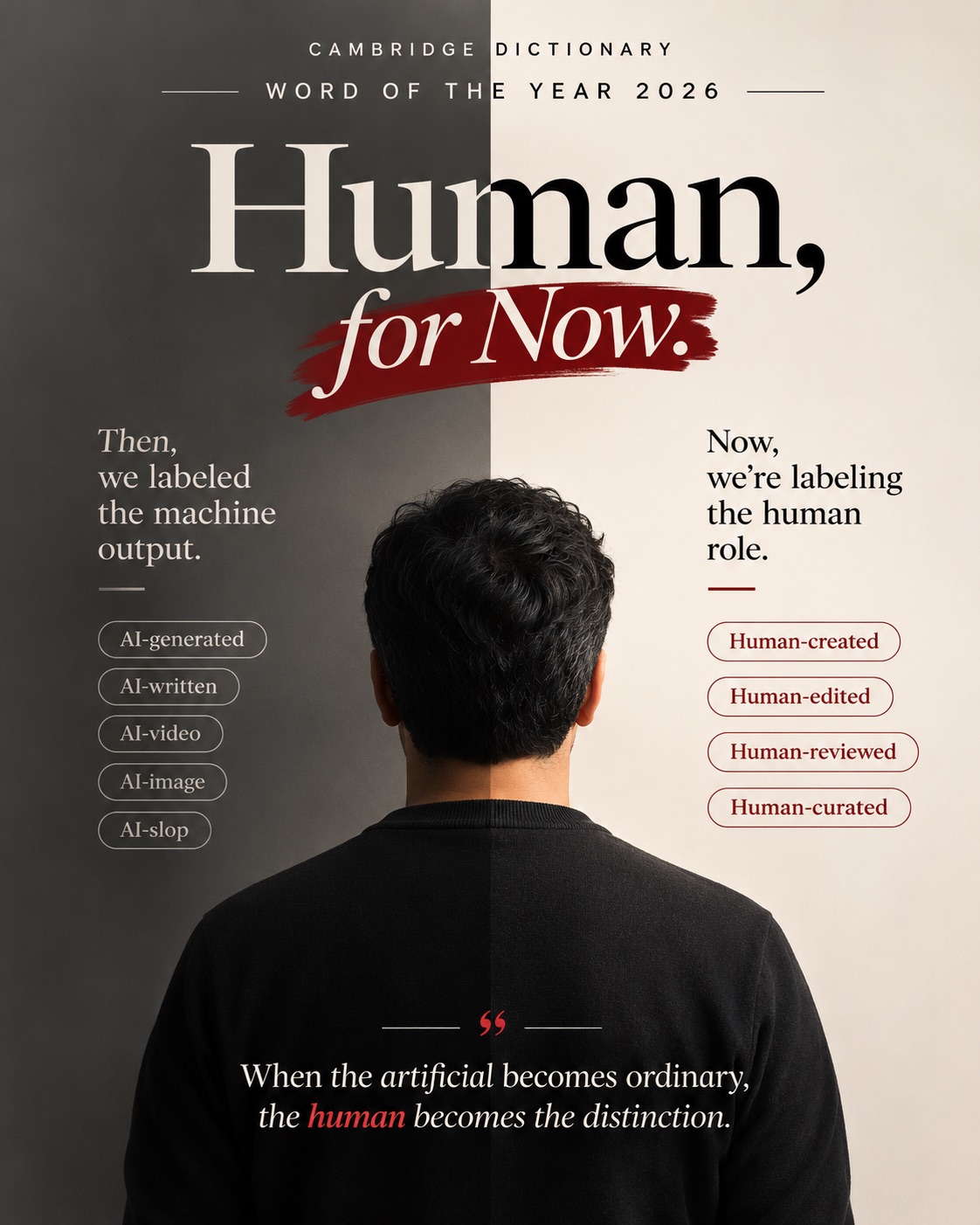
Cambridge Dictionary chose “human” as its 2026 Word of the Year. We used to label what machines could do. Now we’re labeling what humans still do, and the label is only worth something if it says which claim it is making.
-
1
Defaults go unlabeled. Nobody writes “typed” on a letter. The label goes on whatever is unusual, like “handwritten.”
-
2
AI output is becoming the default. So “human” is turning into the marked word, the thing you add when it matters.
-
3
“Human” can mean four different things. Authored, reviewed, in the loop, or accountable. A label that doesn’t say which one is a sticker, not a spec.
What Cambridge actually said
On 17 November 2026 Cambridge Dictionary named human its Word of the Year. The definition it cites is old and plain: having the qualities, faults, and feelings that people have, “as opposed to gods, animals, or machines.” That last word is doing the work this year.
Lexicographer Colin McIntosh put the reason in one line: “AI is changing how we talk about being human.” The announcement collects the evidence. The Authors Guild has launched a “Human Authored” mark for books. Bill Gates writes about “human reserved jobs” such as caregiving. Andy Weir says he might be among the last generation of “fully human writers.” Artists’ groups talk about “human-generated content” versus “machine-generated replicas.”
Read those phrases again and look at where the adjective sits. In every one of them, “human” is a qualifier. It is attached to something that, five years ago, nobody would have thought to qualify.
Defaults don’t get labels
For centuries, human creation needed no disclaimer. It was simply creation.
Linguists have a name for this: markedness. The ordinary case is unmarked. It carries no label because everyone assumes it. The unusual case is marked, and the label is how you flag it.
Everyday language is full of it. A letter is just a letter, but a handwritten letter is worth mentioning. A shirt is just a shirt, but a handmade one gets its own tag. A tomato was just a tomato until industrial farming made “organic” the thing worth saying. In each case the label moved to the exception the moment the default changed.
The label rarely means “better.” It means “this was made in a way you shouldn’t assume.” Sometimes that difference carries value. Sometimes it only carries information.
The adjective is changing sides
Then AI arrived, and we labeled the exception. We started with the artificial: AI-generated, AI-written, AI-edited, AI art, AI slop. Content policies, platform toggles and disclosure rules all marked the machine side, because the human side was the assumed baseline.
Now the exception is becoming ordinary, and the ordinary is becoming exceptional. So we’re beginning to label the human: human-written, human-created, human-edited, human-reviewed.
That baseline is moving. In my own work, a first draft of a design note, a test file or a summary now usually starts with a model. The interesting fact about a piece of work is no longer “a model touched this.” It is “a person did this specific part.” Cambridge’s list is the language catching up.
| Phase | Unmarked (assumed) | Marked (labeled) |
|---|---|---|
| Before writing tools | Handwritten | Printed, typed |
| After typewriters, PCs | Typed | handwritten |
| Early generative AI | Made by a person | AI-generated |
| Now, in more places | Drafted with a model | Human Authored, human-reviewed |
I am not claiming the last row is universal yet. Plenty of fields still label the machine side, and should. My claim is narrower: the human side now needs a label in enough places that the dictionary noticed.
Where the handwriting analogy breaks
The handwritten note is a clean picture of the language pattern. It is a bad picture of the authorship question, and I want to be precise about why.
A typewriter changes the method of writing. The person still chooses every word. A language model can change the author. The words may come from the model, with the person choosing among drafts, editing, or barely touching the result. “Typed” never raised the question of who wrote something. “AI-generated” always does.
So the analogy holds for how labels move. It does not hold for what the label means. That gap is exactly why “human” is harder to use well than “handwritten” ever was.
Handwriting tells you about the pen. “Human” is being asked to tell you about the author, the reviewer and the person who answers for it. One word, several jobs.
“Human” is four different claims
Every time I see “human” used as a qualifier around AI, it is making one of four claims. They are not interchangeable, and conflating them is how a label turns into decoration.
| Label | The claim | What would back it | What it doesn’t promise |
|---|---|---|---|
| Human-authored | A person wrote the substance | A defined threshold, like the Guild’s de minimis rule | That it is good |
| Human-reviewed | A person checked it | Who reviewed, against what, and when | That the person wrote any of it |
| Human-in-the-loop | A person has a step in the process | Which step, and whether they can block it | That the person had real authority |
| Human-accountable | A named person answers for the result | A name, not a team or a role | That the person did the work |
The last column matters most. Each label is silent on something people tend to assume it covers. “Human-reviewed” code can be entirely model-written. “Human-in-the-loop” can describe someone clicking Approve on 400 items an hour. A label that leaves its last column to the reader’s imagination is borrowing trust it hasn’t earned.
The sticker problem
The Authors Guild mark is a useful counterexample because it is not just a word. It is a certification mark. An author or publisher has to register the work and agree to a license. It covers books whose text was “fully authored by one or more human beings and not generated by AI,” with a de minimis exception for things like spelling and grammar checkers.
That is what a label looks like when it has a definition behind it: a threshold, a registration step, and a named exception. You can disagree with where the Guild drew the line. You can’t say the line is vague.
Compare that to “human-crafted” on a landing page, or “reviewed by our experts” at the bottom of a generated article. Same adjective, no process. I expect a lot more of the second kind over the next year, because the word is starting to sell.
Where I’d put it instead
This journal is about specs for AI output, so here is the practical version. I don’t want “human” as an adjective in marketing copy. I want it as structured fields in the artifact’s metadata, one per claim, so nobody has to guess which one is meant.
Software already has a habit for this. Git commit trailers like Signed-off-by: and Reviewed-by: have long separated who wrote a change from who checked it. AI tools now add Co-Authored-By: lines naming the model. The human side deserves the same precision.
provenance:
  drafted_by: model            # which model, which version
  model: claude-opus-5-5
  authored_by_human: partial     # none | partial | full
  human_edits: "restructured sections 2-4, rewrote conclusion"
  reviewed_by: anuj
  review_scope: "facts and sources checked; tone not reviewed"
  accountable: anuj             # a person, never a team
  reviewed_at: 2026-11-21
Rewrite provenance section of output spec

Co-Authored-By: Claude Opus 5.5 <noreply@anthropic.com>
Reviewed-by: Anuj Sadani
Human-Edits: rewrote error handling, kept tests   # not a git convention, yet
Two things I like about this shape. First, authored_by_human: partial is honest in a way the adjective can never be, because it admits the middle ground most real work lives in. Second, review_scope forces the reviewer to say what they did not check, which is the column every label leaves blank.
Human, for now
Will the label last? I see two paths, and I think both happen, in different places.
In routine work, “human” fades the way “typed” did. Nobody will label an internal status update or a generated test fixture. The question stops being interesting once the answer is almost always “a model, and someone glanced at it.”
Where provenance carries value or risk, the label hardens. Books, journalism, legal documents, medical notes and code that ships to production will need to say who wrote what and who answers for it. My bet is that it hardens into fields and certifications rather than staying an adjective, because an adjective can’t say partial and can’t name a reviewer.
That is why I read Cambridge’s choice as a word for a transition. “Human” is the adjective we need while the default is moving. Once it settles, the useful version of the word won’t be on the cover. It will be in the metadata.
Perhaps the biggest sign of AI becoming normal isn’t that we stop calling it artificial. It’s that we start calling ourselves human.
The frame to leave on
- We used to label what machines could do. Now we’re labeling what humans still do.
- On its own, “human” is four claims pretending to be one. Say which: authored, reviewed, in the loop, or accountable.
- A label with no process behind it is a sticker. Put the claim in a field, with a name and a scope.
Fitting for the topic: I drafted this with AI assistance. The argument, the edits and the responsibility for every claim are mine. Sources: Cambridge Dictionary Word of the Year 2026 and the Authors Guild Human Authored usage guidelines.